What is IELTS? A Complete Beginner's Guide
Learn "what is IELTS ?", how the exam works, its types, scoring system, and preparation tips in this complete beginner's guide for study, work, and immigration success. contact 087935 71908
Dr. Avinash , PhD (HRM), MBA (HRM), MSc (Stats), MSc (Med), PGDHRM, DHRM, DIM, PGDIM, PGDIBO, Director and CEO, IELTS Coaching - Impact Overseas Education
6/9/20263 min read
What is IELTS ? A Complete Beginner's Guide
By
IELTS Coaching Center- Impact Overseas Education, https://www.ieltscoachingclassesnashik.com/
Introduction
If you are planning to study, work, or migrate to an English-speaking country, you may have come across the term IELTS. It is one of the world's most recognized English language proficiency tests and is accepted by thousands of universities, employers, and immigration authorities worldwide.
This beginner's guide will help you understand what IELTS is, why it is important, how the exam works, and how you can prepare effectively.
What is IELTS?
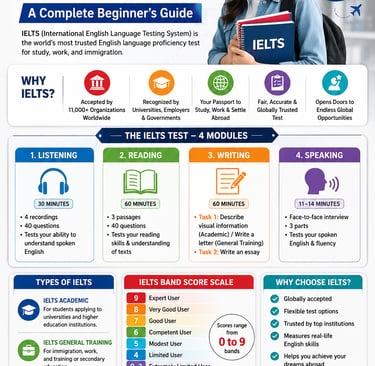
IELTS (International English Language Testing System) is an internationally recognized English language proficiency test designed to assess the language abilities of people who wish to study, work, or migrate to countries where English is the primary language of communication.
The test evaluates four key language skills:
Listening
Reading
Writing
Speaking
IELTS is jointly managed by the British Council, IDP Education, and Cambridge English.
Why is IELTS Important?
IELTS is widely accepted by:
Universities and colleges
Employers
Professional bodies
Immigration authorities
Government organizations
A good IELTS score can help you:
Gain admission to international universities
Obtain a student visa
Apply for permanent residency
Improve employment opportunities abroad
Demonstrate your English communication skills
Types of IELTS Tests
There are two main types of IELTS examinations:
1. IELTS Academic
The Academic version is suitable for:
Students applying to universities and colleges
Individuals seeking professional registration
Candidates pursuing higher education abroad
2. IELTS General Training
The General Training version is suitable for:
Immigration purposes
Work-related applications
Secondary education and training programs
The Listening and Speaking sections are the same for both tests, while the Reading and Writing sections differ.
IELTS Test Format
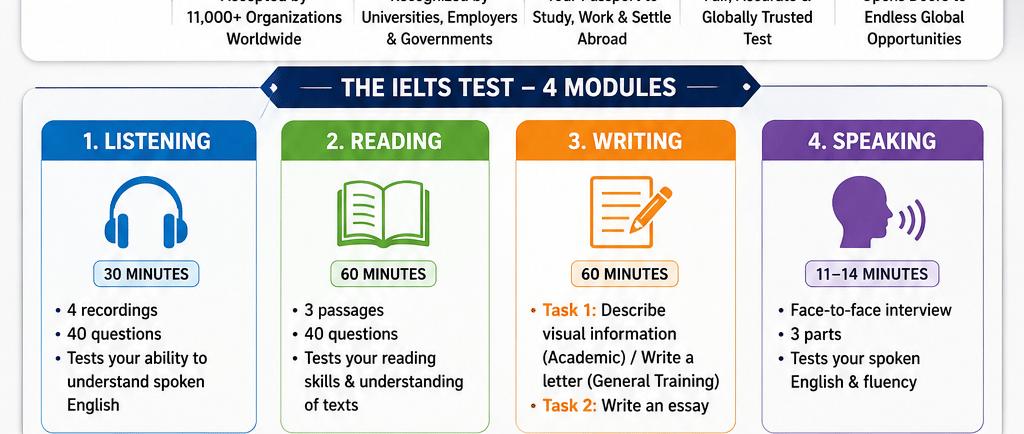
The IELTS examination consists of four sections:
Module Duration
Listening 30 minutes
Reading 60 minutes
Writing 60 minutes
Speaking 11–14 minutes
The total test duration is approximately 2 hours and 45 minutes.
IELTS Listening Section
The Listening test contains four recordings featuring native English speakers.
You will listen and answer questions based on:
Conversations
Discussions
Academic lectures
Everyday situations
Skills Assessed
Understanding main ideas
Identifying specific information
Following conversations
Recognizing opinions and attitudes
IELTS Reading Section
The Reading section assesses your ability to understand written English.
Academic Reading
Includes:
Academic articles
Research-based texts
University-level passages
General Training Reading
Includes:
Advertisements
Notices
Workplace documents
General-interest articles
Skills Assessed
Skimming
Scanning
Understanding details
Identifying arguments
IELTS Writing Section
The Writing section consists of two tasks.
Academic Writing
Task 1: Describe visual information such as:
Graphs
Charts
Tables
Diagrams
Task 2: Write an essay on a given topic.
General Training Writing
Task 1: Write a letter (Formal / Informal) - 150 Words
Task 2: Write an essay (250 Words)
Skills Assessed
Grammar
Vocabulary
Coherence and cohesion
Task achievement
IELTS Speaking Section
The Speaking test is conducted face-to-face with an examiner and is divided into three parts.
Part 1: Introduction and Interview
Questions about:
Family
Studies
Work
Hobbies
Part 2: Cue Card
You will speak on a given topic for 2 minutes.
Part 3: Discussion
A deeper discussion related to the cue card topic.
Skills Assessed
Fluency
Pronunciation
Vocabulary
Grammatical accuracy
IELTS Band Score System
IELTS scores range from Band 0 to Band 9.
Band Score Skill
Level 9 Expert User
Level 8 Very Good User
Level 7 Good User
Level 6 Competent User
Level 5 Modest User
Level 4 Limited User
Level 3 Extremely Limited User
Level 2 Intermittent User
Level 1 Non-User
Level 0 Did Not Attempt Test
The overall score is calculated from the average of all four sections.
What IELTS Score Do You Need?
The required IELTS score depends on your destination and purpose.
Typical requirements:
Diploma Programs: 5.5–6.0
Bachelor's Degree: 6.0–6.5
Master's Degree: 6.5–7.0
Professional Registration: 7.0+
Immigration Programs: Varies by country
Always check the specific requirements of the institution or immigration authority you are applying to.
Computer-Based vs Paper-Based IELTS
Candidates can choose between:
Computer-Delivered IELTS
Reading, Writing, and Listening on a computer
Faster result processing
Paper-Based IELTS
Traditional paper-and-pencil format
Suitable for candidates comfortable with handwritten responses
The Speaking test remains the same in both formats.
How to Register for IELTS
The registration process typically involves:
Choosing Academic or General Training
Selecting a test date
Choosing a test center or computer-based test
Completing the application form
Uploading identification documents
Paying the examination fee
Tips for IELTS Beginners
Start Early
Give yourself at least 6–8 weeks of preparation.
Practice Daily
Spend time improving all four language skills.
Learn New Vocabulary
Read newspapers, blogs, and academic articles regularly.
Take Mock Tests
Practice under exam conditions to build confidence.
Focus on Time Management
Many candidates lose marks because they cannot complete sections on time.
Improve English Exposure
Watch English movies, listen to podcasts, and engage in English conversations.
Common Mistakes to Avoid
Ignoring instructions
Memorizing essays or speaking answers
Poor time management
Lack of practice tests
Weak grammar and vocabulary
Not reviewing mistakes
By
Dr. Avinash, PhD (HRM), MBA (HRM), PGDHRM, DHRM, DIM, PGDIM, PGDIBO,
CEO, Impact Overseas Education (Cell: 0- 8793571908)
British Counsel: https://www.britishcouncil.co/en/english-exam/ielts/preparation
Cambridge : https://www.cambridgeenglish.org/exams-and-tests/ielts/preparation/
English Test Store : https://englishteststore.net/
Guidance
Training
impactoverseasedu@gmail.com
+91- 87935 71908
© 2025. All rights reserved Impact Overseas Education
Do The Free IELTS Practice Test Here: