A Comprehensive IELTS Preparation Plan for Beginners
Discover a complete IELTS preparation plan for beginners, including study schedules, expert tips, practice strategies, and proven techniques to help you achieve your target band score.
6/14/20264 min read
Complete IELTS Preparation Plan for Beginners
By
IELTS Coaching - Impact Overseas Education, https://www.ieltscoachingclassesnashik.com/
Introduction
The International English Language Testing System (IELTS) is one of the most widely accepted English proficiency examinations for students, professionals, and immigrants worldwide. Whether you are planning to study abroad, apply for a work permit, or migrate to an English-speaking country, achieving a good IELTS score can significantly improve your opportunities.
For beginners, IELTS preparation may seem overwhelming due to its four sections—Listening, Reading, Writing, and Speaking. However, with the right strategy, consistent practice, and proper time management, anyone can achieve their target band score.
This comprehensive IELTS preparation plan will help beginners understand the exam structure, create an effective study schedule, and prepare confidently for test day.
Understanding the IELTS Exam
Before starting your preparation, it is important to understand the exam format.
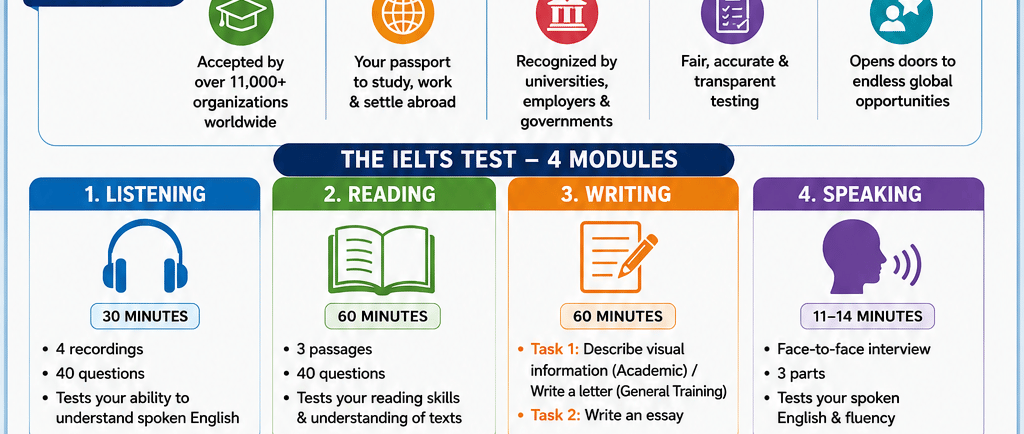
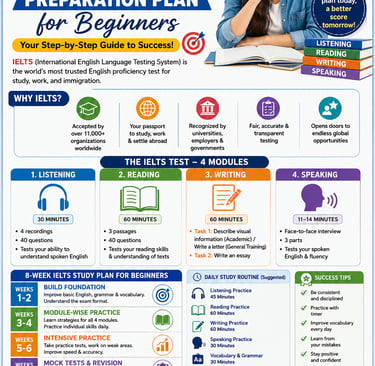
The IELTS test consists of four modules:
Module Duration
Listening 30 Minutes
Reading 60 Minutes
Writing 60 Minutes
Speaking 11-14 Minutes
There are two versions of IELTS:
IELTS Academic: Suitable for students applying to universities and higher education institutions.
IELTS General Training: Suitable for immigration, work, and vocational training purposes.
The Listening and Speaking sections are identical for both versions, while Reading and Writing differ.
Step 1: Determine Your Target Band Score
Your preparation strategy should begin with identifying your required band score.
Typical IELTS requirements are:
Diploma Programs: 5.5 – 6.0
Undergraduate Programs: 6.0 – 6.5
Postgraduate Programs: 6.5 – 7.0
Professional Registration: 7.0+
Immigration Programs: Varies by country
Knowing your target score helps you focus your preparation effectively.
Step 2: Assess Your Current English Level
Take a diagnostic IELTS mock test before beginning your preparation.
This will help you identify:
Strong areas
Weak areas
Vocabulary level
Grammar proficiency
Time management issues
Once you understand your strengths and weaknesses, you can allocate more study time to the modules that need improvement.
Step 3: Create an 8-Week IELTS Study Plan
An eight-week preparation schedule is ideal for most beginners.
Weeks 1-2: Build Foundation
Focus on:
Basic grammar
Vocabulary development
Understanding IELTS format
Daily English reading
Listening practice
Daily Activities:
Read English newspapers for 30 minutes
Learn 10-15 new words
Listen to English podcasts
Watch English news channels
Weeks 3-4: Module-Based Practice
Begin practicing individual IELTS modules.
Listening
Practice:
Note completion
Multiple-choice questions
Map labeling
Sentence completion
Reading
Practice:
Skimming
Scanning
Identifying keywords
Time management
Writing
Learn:
Essay structure
Paragraph development
Graph description techniques
Speaking
Practice:
Self-introduction
Common IELTS questions
Cue card topics
Weeks 5-6: Intensive Practice
Increase practice intensity.
Daily Schedule:
Listening 45 minutes
Reading 1 hour
Writing 1 hour
Speaking 30 minutes
Begin solving complete IELTS practice tests under timed conditions.
Weeks 7-8: Mock Tests and Revision
Focus on:
Full-length mock tests
Error analysis
Weak area improvement
Time management
Take at least:
4 Listening tests
4 Reading tests
8 Writing tasks
8 Speaking practice sessions
Listening Preparation Strategy
Many beginners find Listening easier than other modules.
How to Improve Listening
Listen to English podcasts daily.
Watch English movies with subtitles.
Practice note-taking while listening.
Learn common IELTS question types.
Common Mistakes
Losing concentration
Spelling errors
Ignoring instructions
Missing answers due to poor attention
Beginner's Goal
Aim for:
30+ correct answers for Band 7
35+ correct answers for Band 8
Reading Preparation Strategy : Reading requires speed and accuracy.
Essential Techniques
Skimming
Quickly read the passage to understand the main idea.
Scanning
Search for specific information without reading every word.
Keyword Identification
Identify keywords in questions and locate them in the passage.
Daily Reading Practice
Read:
Newspapers
Magazines
Academic articles
Blogs
Recommended reading time: 30–45 minutes daily.
Writing Preparation Strategy : Writing is often considered the most challenging module.
Writing Task 1
Academic Candidates: Word Limits (150), Aim for Writing 180 Words
Describe:
Graphs
Charts
Tables
Diagrams
General Training Candidates: Write formal or informal letters.
Writing Task 2
Write an essay of at least 250 words. Aim for Writing 280 Words
Important Essay Types
Opinion Essays
Discussion Essays
Problem-Solution Essays
Advantage-Disadvantage Essays
Writing Improvement Tips
Learn essay structures.
Improve grammar.
Use varied vocabulary.
Practice daily writing.
Speaking Preparation Strategy
The Speaking test evaluates your ability to communicate naturally.
Part 1
Personal questions about:
Studies
Work
Hobbies
Family
Part 2
Cue Card Topic
You speak for 2 minutes and More. Minimum 2 minutes
Part 3
Detailed discussion related to Part 2.
Speaking Tips
Speak confidently.
Avoid memorized answers.
Use natural vocabulary.
Practice speaking every day.
Vocabulary Building Plan
Vocabulary plays a crucial role in all four modules.
Daily Vocabulary Routine
Learn:
10–15 new words daily
Synonyms and antonyms
Academic vocabulary
Topics to Focus On
Education
Technology
Environment
Health
Business
Society
Culture
Example
Instead of saying: "Good"
Use:
Excellent
Beneficial
Valuable
Effective
Grammar Improvement Plan
Strong grammar helps improve Writing and Speaking scores.
Focus on:
Tenses
Subject-Verb Agreement
Articles
Prepositions
Sentence Structure
Passive Voice
Conditional Sentences
Spend at least: 20–30 minutes daily on grammar practice.
Best Resources for IELTS Preparation
Books
Cambridge IELTS Series
Official IELTS Practice Materials
Barron's IELTS
IELTS Trainer
Websites
Official IELTS websites
British Council resources
IDP IELTS preparation materials
Mobile Apps
IELTS Prep App
IELTS Test Pro
Vocabulary Builder Apps
Common Mistakes Beginners Should Avoid
1. Ignoring the Test Format
Understanding the exam structure is essential.
2. Memorizing Answers
Examiners can easily identify memorized responses.
3. Neglecting Vocabulary
Limited vocabulary affects all modules.
4. Poor Time Management
Practice under exam conditions.
5. Not Taking Mock Tests
Mock tests build confidence and improve speed.
6. Focusing Only on One Module
All four modules contribute to your overall score.
One-Day Before the Exam
Do
✔ Revise important strategies
✔ Get adequate sleep
✔ Prepare identification documents
✔ Stay calm and confident
Don't
✘ Learn new topics
✘ Take excessive mock tests
✘ Stay awake late at night
Conclusion
Preparing for IELTS as a beginner does not have to be stressful. Success comes from understanding the exam structure, following a disciplined study plan, practicing consistently, and improving your English language skills every day.
An 8-week preparation plan focusing on Listening, Reading, Writing, and Speaking can help most candidates achieve their desired band score. Remember that IELTS is not just a test of English knowledge—it is a test of communication skills, confidence, and effective time management.
With dedication, regular practice, and the right preparation strategy, you can achieve your target IELTS score and take the next step toward your study, work, or immigration goals abroad.
Dr. Avinash , PhD, PhD (HRM), MBA (HRM), MSc (Stats), MSc (Med), PGDHRM, DHRM, DIM, PGDIM, PGDIBO,
Director and CEO, IELTS Coaching Impact Overseas Education
https://www.ieltscoachingclassesnashik.com/
Call: 087935 71908
British Counsel: https://www.britishcouncil.co/en/english-exam/ielts/preparation
Cambridge : https://www.cambridgeenglish.org/exams-and-tests/ielts/preparation/
English Test Store : https://englishteststore.net/
Guidance
Training
impactoverseasedu@gmail.com
+91- 87935 71908
© 2025. All rights reserved Impact Overseas Education
Do The Free IELTS Practice Test Here: